What is Chaos Theory?


Chaos is the science of surprises, of the nonlinear and the unpredictable. It teaches us to expect the unexpected. While most traditional science deals with supposedly predictable phenomena like gravity, electricity, or chemical reactions, Chaos Theory deals with nonlinear things that are effectively impossible to predict or control, like turbulence, weather, the stock market, our brain states, and so on. These phenomena are often described by fractal mathematics, which captures the infinite complexity of nature. Many natural objects exhibit fractal properties, including landscapes, clouds, trees, organs, rivers etc, and many of the systems in which we live exhibit complex, chaotic behavior. Recognizing the chaotic, fractal nature of our world can give us new insight, power, and wisdom. For example, by understanding the complex, chaotic dynamics of the atmosphere, a balloon pilot can “steer” a balloon to a desired location. By understanding that our ecosystems, our social systems, and our economic systems are interconnected, we can hope to avoid actions which may end up being detrimental to our long-term well-being.

Don't blame me!


Principles of Chaos

  • The Butterfly Effect: This effect grants the power to cause a hurricane in China to a butterfly flapping its wings in New Mexico. It may take a very long time, but the connection is real. If the butterfly had not flapped its wings at just the right point in space/time, the hurricane would not have happened. A more rigorous way to express this is that small changes in the initial conditions lead to drastic changes in the results. Our lives are an ongoing demonstration of this principle. Who knows what the long-term effects of teaching millions of kids about chaos and fractals will be?
  • Unpredictability: Because we can never know all the initial conditions of a complex system in sufficient (i.e. perfect) detail, we cannot hope to predict the ultimate fate of a complex system. Even slight errors in measuring the state of a system will be amplified dramatically, rendering any prediction useless. Since it is impossible to measure the effects of all the butterflies (etc) in the World, accurate long-range weather prediction will always remain impossible.
  • Order / Disorder Chaos is not simply disorder. Chaos explores the transitions between order and disorder, which often occur in surprising ways.
  • Mixing: Turbulence ensures that two adjacent points in a complex system will eventually end up in very different positions after some time has elapsed. Examples: Two neighboring water molecules may end up in different parts of the ocean or even in different oceans. A group of helium balloons that launch together will eventually land in drastically different places. Mixing is thorough because turbulence occurs at all scales. It is also nonlinear: fluids cannot be unmixed.
  • Feedback: Systems often become chaotic when there is feedback present. A good example is the behavior of the stock market. As the value of a stock rises or falls, people are inclined to buy or sell that stock. This in turn further affects the price of the stock, causing it to rise or fall chaotically.
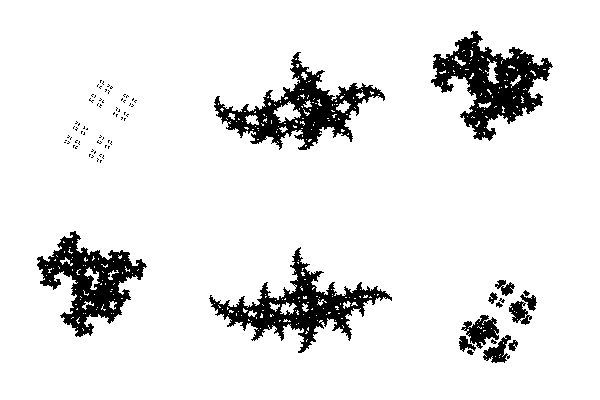
  • Fractals: A fractal is a never-ending pattern. Fractals are infinitely complex patterns that are that are self-similar across different scales. They are created by repeating a simple process over and over in an ongoing feedback loop. Driven by recursion, fractals are images of dynamic systems - the pictures of Chaos. Geometrically, they exist in between our familiar dimensions. Fractal patterns are extremely familiar, since nature is full of fractals. For instance: trees, rivers, coastlines, mountains, clouds, seashells, hurricanes, etc.
“As far as the laws of mathematics refer to reality, they are not certain, and as far as they are certain, they do not refer to reality.”

-Albert Einstein


-Albert Einstein


Comments

9 Responses to “What is Chaos Theory?”
  1. Louise says:

    Dear Fractal Folk
    Thank you for sharing the wonderful world of fractals! I have visited your site many times since finding it about a year ago and am encouraging my kids to take an interest. Thank you. Louise, Australia

  2. melvin goldstein says:

    Chaos is one of Physics Foibles. As Godel revealed – maybe we can’t prove everything!! long term weather prediction is trumped by Chaos Theory.

  3. somayeh says:

    Thank you for your useful writing.It helped me to write my article.Somayeh,Iran,Khomeini shahr

  4. i think each and erything in the universe inter related and interconnected.

  5. meteorologicalengineer says:

    A puzzle for “chaos thinking” is that the universe is NOT chaotic in the sense of actual butterfly wings having an effect even one meter away, never mind Texas. The world of reality is not an approximation. By contrast, the world of chaos theory is full of approximations, because one CANNOT specify initial conditions to an infinite degree.

    The “butterfly effect” does not apply to the macroscopic real world. The “butterfly effect” is a mathematical construct, or perhaps better, an artifact of “digitization for computation.” Beautiful, but not real.

  6. Paul Koszarny says:

    I have my objections to what meteorologicalengineer wrote. He is wrong on what mathematically “initial conditions” are and as a result he claims that chaos deals with a lot of approximations. That is entirely untrue because chaos is remarkably precise in terms of chaotic behavior. Turbulences, triggers, fractal expansions, borders of chaos possess the quality of exactness. The key feature of chaotic behavior is order and precision. It is also untrue that “the butterfly effect” is a construct or an artifact nonexistent in reality. I can present loads of heuristic evidence from the financial charts like indices, stocks, bonds and currencies falsifying meateorologicalengineer’s conjecture.
    It also forces me to ask him, do you really think that mathematics together with its constructs and artifacts is simply manmade? The theory of chaos denies it.

  7. Ahmad says:

    I do agree with the engineer with the world of chaos theory is full of approximations and Paul for chaotic behavior. Imagine if, the butterfly can affect in some way the world, how would effect: the direct and horrible acts like; war, terrorism, war and violent movie or war-game and more and more… which in every second has a direct influence in our world and life, as Calvino says, rains in our mind.

  8. Eric says:

    I am by no means an expert in the field of nonlinear dynamics, but I’ve taken a few college courses on it and I’ve read a few pop-science books (Chaos by James Gleick is great, as is Does God Play Dice? by Ian Stewart). So, I consider myself knowledgeable enough on the subject to clarify a few points. The beauty of so-called “chaos math” is that we can simulate impossibly complex systems (i.e. everyone’s favorite, weather) with incredibly simple models. Even more importantly, the behavior of those simple systems is complex and erratic. I forget which of the two books I mentioned before the quote is in, but one of my favorite quotes about models used in nonlinear dynamics is paraphrased as “there is no point in having a map of a city which is as large and complex as the city itself”. What this means is that mathematicians want to model complex activity with as simple of a model as possible. This is the inherent beauty of chaos.

    Now, on a more personal aside, I have a pet peeve against the phrase “butterfly effect”. It’s misleading, in my opinion. It gives the layperson a nice perspective, but the way it’s portrayed (”a butterfly flapping its wings causes a hurricane across the globe”) implies a direct causality. The effect is not that straightforward, which I think is the point the meteorological engineer is trying to make.

  9. E.S. Roller says:

    My perspective, obviously, is a stark contrast to the calculating outlook some in math and science tend to have. I am horrible at math/physics, but I have a tremendous respect and admiration for their tremendous power. So here’s the artist/spiritualist perspective: Chaos theory existed long before the great minds of physics and mathematics named it such. In fact, the Chinese word for “chaos” contains the root word meaning “opportunity”. Dating some philosophies and ideas of chaos theory around the 14th century B.C. Although the connection may seem like grasping straws to some, the study of alchemy (which evidence suggests occured as early as ancient Sumeria) directly correlates with some of the ideas of chaos theory in very transcendent ways. Though equations may sometimes seem to disprove or augment our core ideas of what is natural or “real”, more often than not it is information we lack that renders our understanding, which is received through lifetimes of apt research and relentless study. Perhaps we do not understand reality to the extent in which science leads us to believe. History is full of prideful human error made by many ingenious minds, swept away by the vastness of their own intelligence. To make my point, many scholars, philosophers, psychologists, physicists etc. have dedicated a portion, if not the entirety of their lives piecing together the mysteries of global consciousness and interconnectedness as well as the intimate relationship between order and disorder. Carl Jung spent a great deal of time on the subject of enlightenment by means of chaos. The butterfly effect is indeed indirect when we investigate the lineage of cause and effect, however the point is not HOW influential the butterfly is but rather that it has any influence at all. The idea of a universal consciousness is becoming more feaseable with the help of science and mathematics, that we somehow affected the butterfly, who affected the hurricane, which affected us (to grossly oversimplify), a never ending fractal cycle of cause and effect. Lately, those seasoned in hard fact finding have had to play a bit of catch up with metaphysics, as larger numbers of people have spiritual or unexplainable experiences in their lives that have nothing to do with religion and actually, more to do with the ideas of chaos theory.

Feedback Please

Let us know what you think...